 FlaskConnect™
Home › Apparatus gallery › Fractional distillation
Fractional Distillation Apparatus Diagram (Vigreux Column, Labeled, Free SVG/PNG)
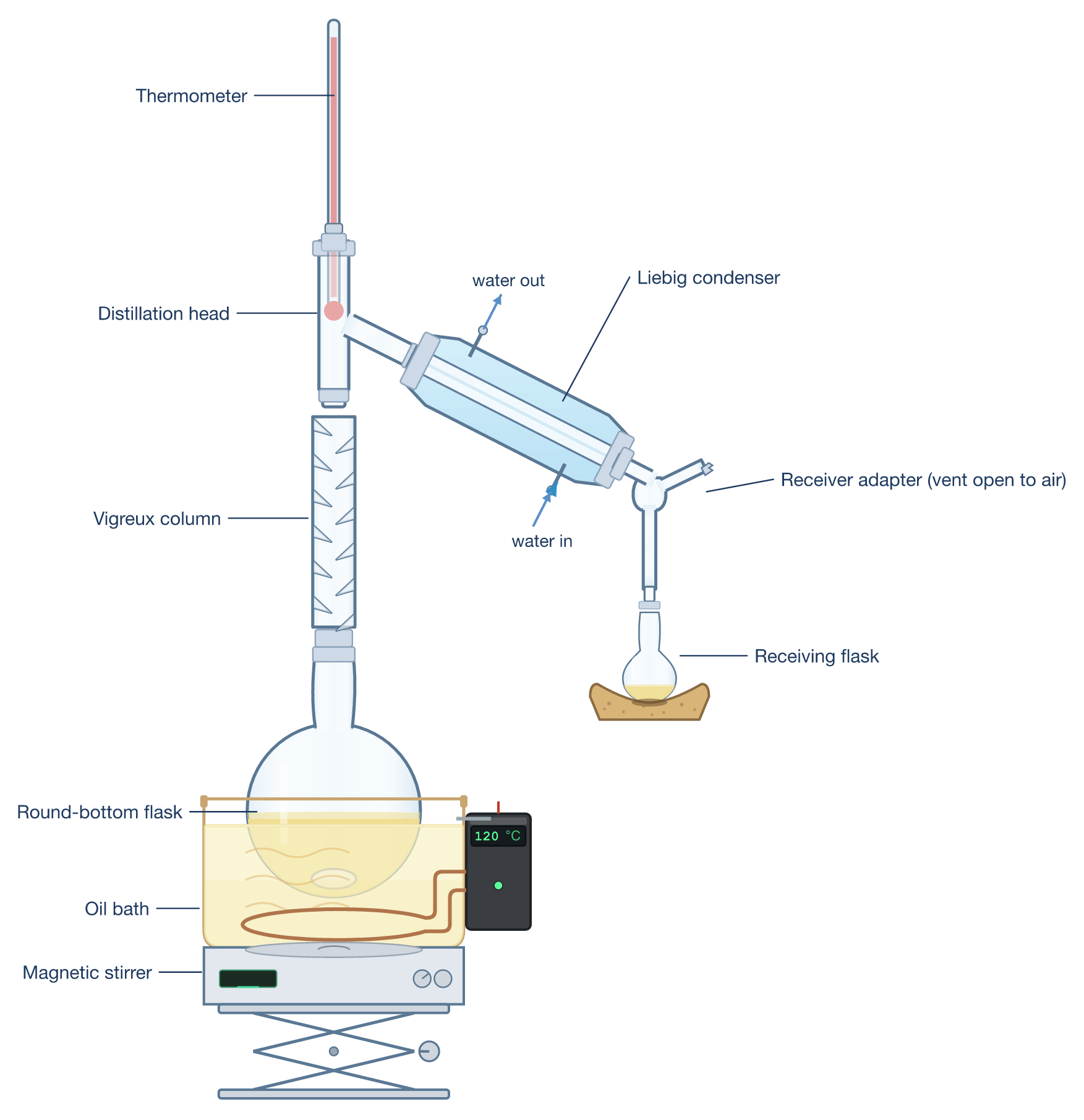
Fractional distillation separates liquids with close boiling points. A fractionating column between the flask and the distillation head lets the vapor condense and re-vaporize many times, so the more volatile component comes over first.
.chemc is a FlaskConnect drawing file. Open it in the free FlaskConnect app to change the glassware, labels and layout before exporting (double-click it on Mac or Windows; on iPad, open it from the Files app and choose FlaskConnect).
Free to use without attribution in lab reports, theses, teaching materials, slides, supporting information and on the web, including modified and commercial use. Released under CC0 1.0 (public domain dedication).
How fractional distillation works
As vapor rises through the fractionating column, part of it condenses on the inner wall and the indentations, then re-vaporizes as hotter vapor comes up from below. Each condensation and re-vaporization enriches the vapor in the more volatile (lower-boiling) component, so near the top of the column the vapor is almost pure in that component.
Each ideal condense-and-vaporize step is called a theoretical plate. A longer column, or one with packing that gives more surface, has more theoretical plates and can separate liquids with closer boiling points.
Equipment
- Round-bottom flask
- Fractionating column (such as a Vigreux column)
- Distillation head
- Thermometer
- Liebig condenser
- Receiver (vacuum) adapter with a side arm
- Receiving flasks (change for each fraction)
- Oil bath, magnetic stirrer and stir bar
- Coolant
Setup tips
- Mount the fractionating column vertically between the flask and the distillation head.
- Set the top of the thermometer bulb level with the bottom of the side arm of the distillation head.
- Heat gently and keep the distillate coming over slowly and steadily. Distilling too fast does not give the column time to separate the components.
- If the vapor does not reach the top of the column, wrap the column in aluminum foil or glass wool to reduce heat loss.
- Change receivers when the head temperature changes, collecting each fraction (forerun, main fraction and so on) separately.
- Keep the system open to the air somewhere (the side arm of the receiver adapter) and never distill to dryness. Run the coolant in at the lower inlet and out at the upper outlet.
Common mistakes
- Heating hard to distill quickly (the column floods and the separation is lost).
- The thermometer bulb sits above or below the side arm (wrong temperature reading).
- The receiver side is sealed too (side arm blocked).
- Distilling until the flask is dry.
FAQ
- What is the difference between simple and fractional distillation?
- Simple distillation puts the distillation head directly on the flask, so the vapor condenses only once. Fractional distillation adds a fractionating column in between, where the vapor condenses and re-vaporizes many times, so liquids with close boiling points can be separated.
- What is a Vigreux column?
- A fractionating column with rows of glass indentations on the inside. It needs no packing and holds up little liquid, but has fewer theoretical plates than a packed column.
- Why should fractional distillation be slow?
- The column needs time for condensation and vaporization to reach balance. If the distillate comes over too fast, the vapor reaches the top before it has been separated, and the fractions are mixed.
- Why wrap the column?
- If the column loses heat, the vapor condenses and runs back into the flask before it reaches the top. Wrapping it in aluminum foil or glass wool helps the vapor rise to the distillation head.
- Can I use this diagram in my lab report?
- Yes. It is released under CC0, so you can use and modify it without attribution. Open the .chemc file in FlaskConnect to change the glassware or labels before exporting.
Always follow your institution's safety rules and your supervisor's instructions.
Draw this in the app
This diagram was drawn in FlaskConnect. Pick the glassware and it connects itself, coolant lines and all, in a few minutes. Apparatus drawing and export (SVG, PNG, PowerPoint, Word, Excel) are free.