 FlaskConnect™
Home › Apparatus gallery › Curved arrows (electron movement)
Curved Arrow Diagrams: Showing Electron Movement (Acid–Base, Addition to C=O, Cl₂ Homolysis)
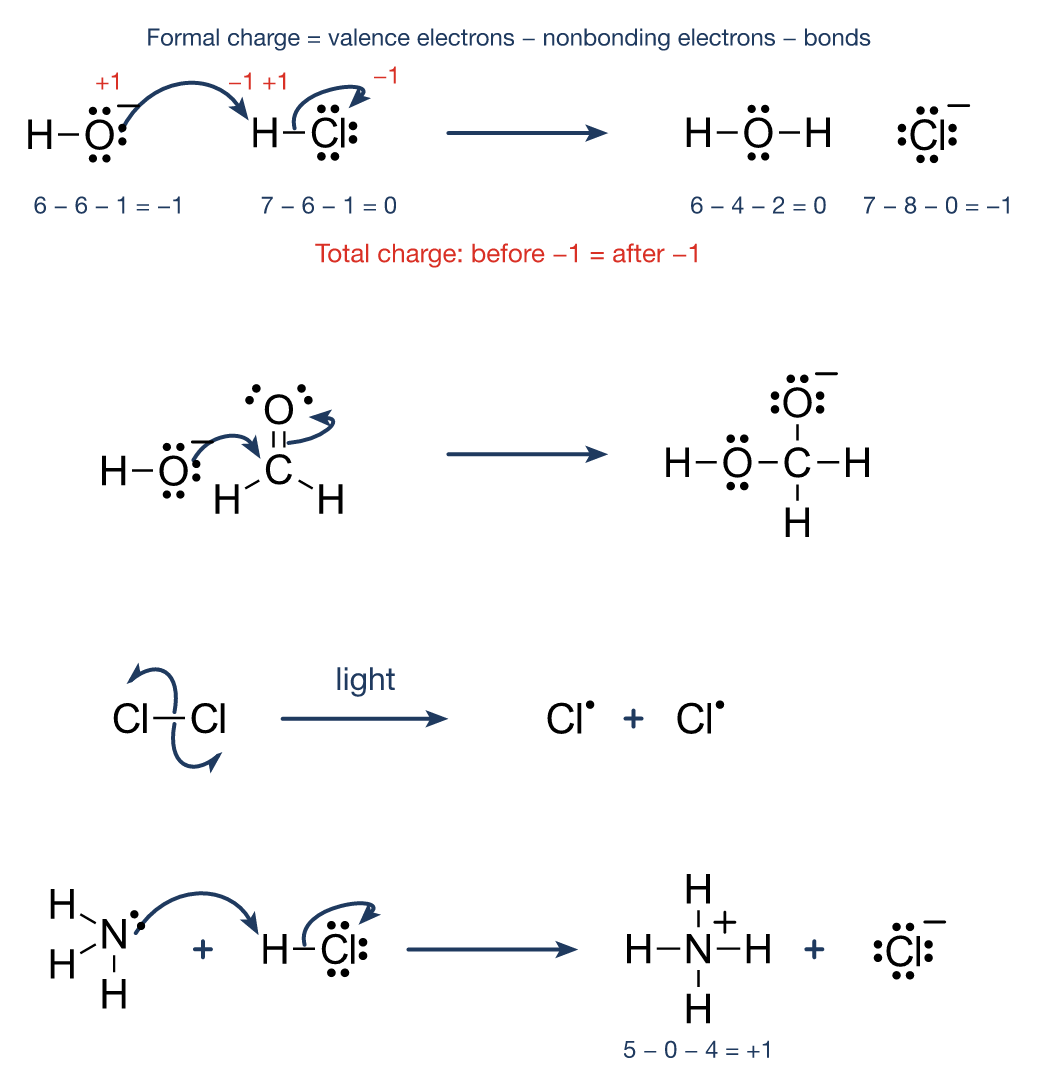
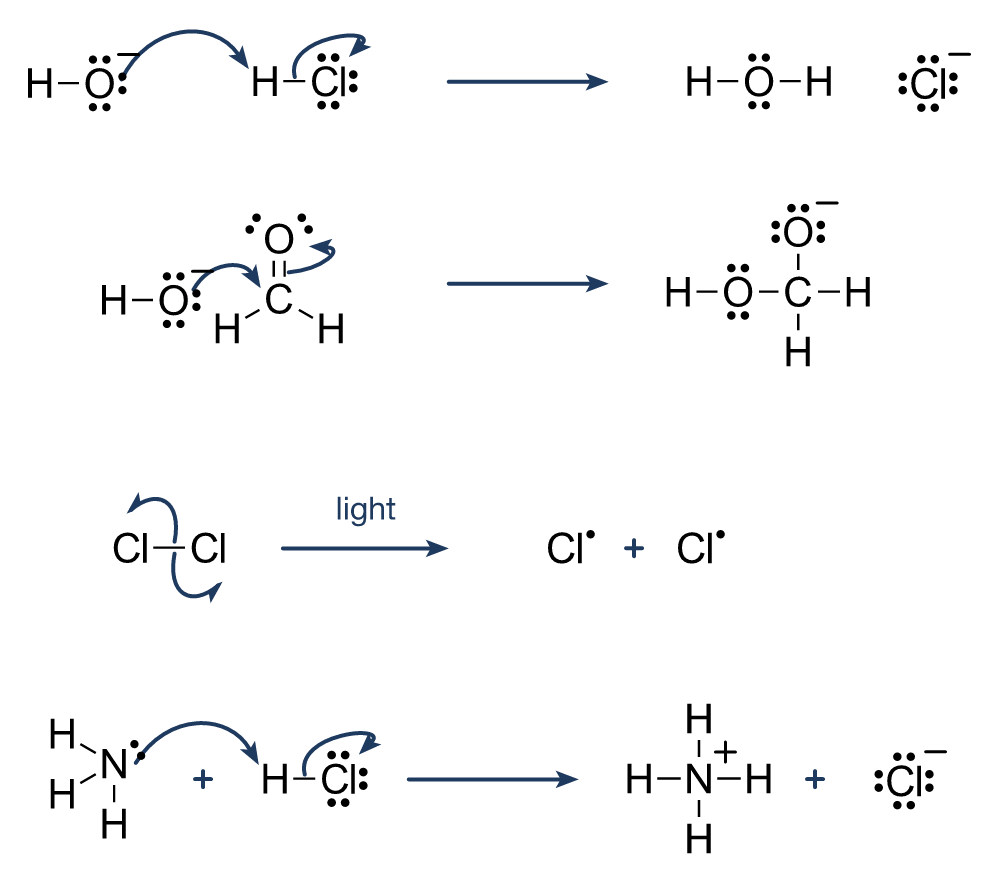
Curved arrows show how electrons move. An arrow starts where the electrons are (a lone pair or the middle of a bond) and ends where they go (an atom forming a new bond, or an atom that takes the pair). An arrow that starts from a bond curves with the atom that keeps the pair on the inside. These figures were drawn in FlaskConnect for Episode 1 of “Organic Chemistry with Flako” on YouTube.
.chemc is a FlaskConnect drawing file. Open it in FlaskConnect to adjust the text and layout before exporting (double-click it on Mac or Windows; on iPad, open it from the Files app and choose FlaskConnect). Opening, moving and exporting are free; editing structures and schemes requires Pro.
Free to use without attribution in lab reports, theses, teaching materials, slides, supporting information and on the web, including modified and commercial use. Released under CC0 1.0 (public domain dedication).
Features used in this figure
- Structures (hydrogens drawn as atoms so every bond shows)
- Lone pairs and charges
- Curved arrows (full head = 2 electrons, fishhook = 1 electron)
- Unpaired electrons (radical dots)
- Text above the reaction arrow (light) and formula notes
How to draw it in FlaskConnect
- In the Structure tab, place atoms and connect them with bonds. Here hydrogens are placed as atoms so the number of bonds shows.
- Right-click an atom and choose Lone Pairs to set the number of pairs (three on the O of HO⁻, four on Cl⁻). Click with the charge tool for + (Shift for −).
- With the curved-arrow tool, drag from a lone pair (or the middle of a bond) to where the electrons go. Fix the bulge with the handles.
- For a one-electron arrow, select the curved arrow and change its head to Fishhook. For Cl₂ homolysis, draw one from the middle of the bond to each Cl.
- Add unpaired electrons with the radical tool (click to cycle none, one dot, two dots).
- Add the formal-charge formula and calculations as text notes.
Notation tips
- Curved arrows show electrons, not atoms. Never draw an arrow that moves an atom (such as H⁺): an arrow from H to O is wrong.
- Start at a lone pair or the middle of a bond; end at the atom forming a new bond, or at the atom that takes the pair.
- An arrow that starts from a bond curves with the atom that keeps the bonding pair on the inside (the concave side).
- A full (double-barbed) head moves two electrons; a half (single-barbed, fishhook) head moves one. Cl₂ homolysis uses two fishhook arrows and leaves one unpaired electron on each Cl.
- Formal charge = valence electrons in the neutral atom − nonbonding electrons − bonds. The total charge is the same before and after (HO⁻ + HCl: −1 before, −1 after).
- The red numbers track the charge change for each arrow: the atom the electrons leave goes +1, the atom they reach goes −1. In HO⁻ + HCl, O goes from −1 to 0, H stays at 0 (+1 and −1), and Cl goes from 0 to −1.
- Where an arrow makes a new bond, check that the atom stays within its limit (4 bonds for carbon, 1 for hydrogen). If it would go over, another arrow must take electrons away from it.
- Bringing open bottles of aqueous ammonia and concentrated hydrochloric acid together makes white smoke (ammonium chloride). Only try this in a fume hood, with supervision.
The conventions follow the web supplement S5.1 to Organic Chemistry, 1st ed. (Maruzen; Okuyama, supervising editor), and lecture notes from Meijo University (Fundamentals of Organic Chemistry, chapter 5), both in Japanese. The figures were drawn anew in FlaskConnect and are not reproductions of figures from those sources.
Watch the lesson on YouTube
A lesson that uses these figures (opens on YouTube).
Draw this in the app
This figure was drawn in FlaskConnect. Call up structures by name or SMILES, and add lone pairs, curved arrows and arrow text (subscripts and superscripts with buttons) in place. Drawing structures and schemes is Pro (US$3.99/month, first month free, or US$39.99 once); apparatus drawing and export are free.